No Textbook, No Blueprint, No Problem: The Teenage Immigrants Who Built What America Didn't Know It Needed
The standard American engineering origin story has a certain shape to it. MIT or Stanford. A mentor who saw potential early. Maybe a garage. Definitely a whiteboard.
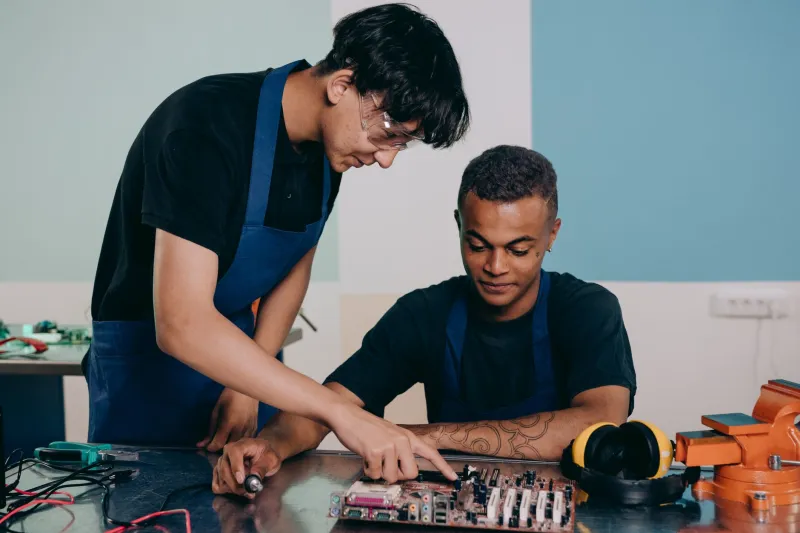
But some of the most consequential technical minds in recent American history don't fit that shape at all. They arrived as teenagers who couldn't order food in English, attended schools that didn't know what to do with them, and learned their craft through a combination of YouTube tutorials, library scavenging, broken machines, and sheer refusal to accept that not understanding something meant you couldn't figure it out.
Their outsider status wasn't a disadvantage they overcame. In many cases, it was the engine.
Seeing What Familiarity Hides
There's a concept in psychology called functional fixedness — the tendency to see an object or a system only in terms of its conventional use. The more familiar you are with something, the harder it becomes to imagine it working differently.
Immigrant teenagers, by definition, don't have that problem. They arrive without the cultural script that tells them how things are supposed to work. And in that gap — between what they observe and what they were conditioned to expect — some of them find the questions that matter most.
Ana Folau arrived in California from Tonga at fifteen with no formal English instruction and a middle school education that had focused heavily on agriculture and basic math. Her family settled in the Central Valley, and she spent her first two years in the US in ESL classes that moved too slowly for her restless brain. She picked up English by watching cooking shows and reading appliance manuals she found at Goodwill — not because she was particularly interested in appliances, but because the diagrams made the language make sense.
That instinct for diagrams — for understanding systems visually before verbally — turned out to be foundational. By nineteen, Folau was auditing community college courses in electrical engineering. By twenty-four, she had co-founded a small firm designing low-cost solar installation systems specifically engineered for mobile home communities — a market that larger solar companies had consistently ignored as too fragmented and economically marginal.
"Nobody was building for those neighborhoods because nobody who designs energy systems grew up in one," she said at a California clean energy conference in 2021. "I did. So I knew what the actual problem was."
The Problem With Knowing Too Much
Miguel Serrano came from a small city in Honduras at sixteen, joining an uncle in Houston. He enrolled in a high school that placed him in remedial courses despite the fact that he had been an advanced student back home — his English scores had flagged him as behind, and the system didn't look much further than that.
Serrano was bored. Dangerously, productively bored.
He started spending afternoons at a public library, teaching himself programming through free online platforms. He didn't learn to code the way a computer science student would — methodically, conceptually, in sequence. He learned it the way someone learns a language by necessity: by trying to make something specific work, failing, Googling the error message, trying again.
What he built first was a simple scheduling tool for his uncle's landscaping business, which ran on handwritten notes and a lot of phone calls. The tool worked. Then he built a better version. Then he started noticing that every small landscaping and lawn care operation in his neighborhood had the same problem: no affordable software that worked in both English and Spanish, designed for owners who weren't tech-savvy in either language.
He built that too. He was twenty years old. The platform now serves over 3,000 small landscaping businesses across Texas and Florida.
When asked what formal training had shaped his approach to product design, Serrano pauses. "I didn't really have formal training," he says. "I just kept asking: what does someone like my uncle actually need? Not what does the software manual say he needs."
Mentorship in Unexpected Rooms
Not every self-taught immigrant engineer found their footing alone. Many credit informal mentors — a factory supervisor who let them stay late and ask questions, a librarian who ordered specific books on request, a neighbor who happened to have an engineering background and recognized something worth nurturing.
Diep Nguyen arrived in Virginia from Vietnam at fourteen, speaking no English and carrying a notebook filled with hand-drawn mechanical sketches she'd been making since childhood. She ended up in a vocational track at her high school — partly by default, partly because a guidance counselor noticed the notebooks and made a quiet judgment call that turned out to be exactly right.
In her junior year, Nguyen's shop class teacher — a retired machinist named Harold Briggs — recognized that she was operating several levels above her classmates. He started leaving advanced technical manuals on her workbench. He connected her with a local manufacturing company that offered a part-time apprenticeship. He wrote her a college recommendation letter that, by her own account, described her in terms that changed how she saw herself.
"He told me I had the mind of an engineer," Nguyen says. "I didn't know that was a thing I could be."
She went on to earn a mechanical engineering degree at Virginia Tech and now leads a manufacturing innovation lab focused on precision components for medical devices. She mentors first-generation college students — many of them recent immigrants — as a matter of personal priority.
The Edge That Comes From the Outside
What unites these stories isn't just resilience, though there's plenty of that. It's a specific kind of cognitive flexibility that comes from having to learn everything from scratch, without assumptions.
When you don't know what's impossible, you sometimes build it anyway.
When you don't know the "right" way to solve a problem, you find your own way — and sometimes your own way is better.
When you've had to decode an entire culture through observation and trial and error, spotting gaps in a market or a system starts to feel almost natural. You've been doing it your whole life.
America has always been built, in part, by people who arrived with nothing but nerve and necessity. The engineers in these stories are part of that tradition — even if their names don't appear in any textbook yet.
Give it time.