He Lost His Eyes and Saw the World More Clearly Than Anyone
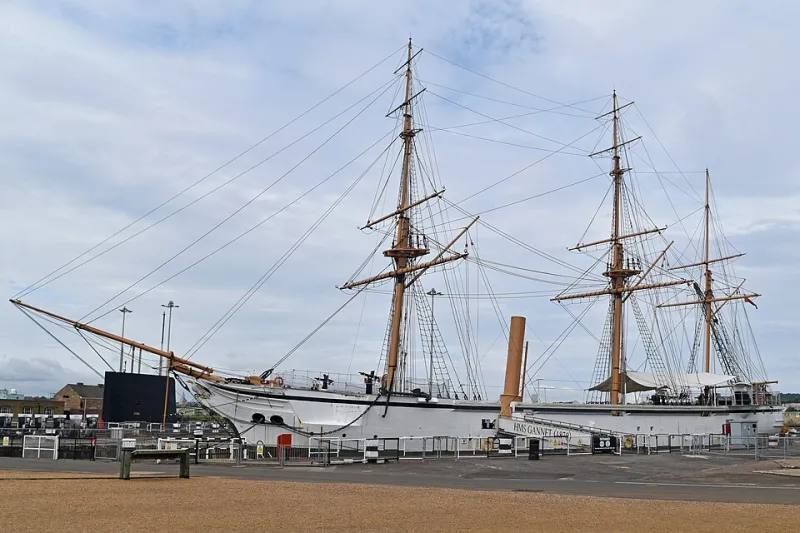
Photo: HawkeyeUK, CC BY-SA 2.0, via Wikimedia Commons
In 1810, a young Royal Navy officer named James Holman sat in a military hospital in Edinburgh and was told, with the practiced calm of British military medicine, that he was going blind. He was 25. He had spent his entire adult life at sea, had seen combat, had watched coastlines materialize out of morning fog. And now, the doctors told him, he would never see anything again.
 Photo: James Holman, via cache.legacy.net
What they didn't tell him — because they couldn't have known — was that losing his sight would make him the most widely traveled explorer of the 19th century. More than that, it would make him a better one.
The Navy Sent Him to Retire. He Had Other Plans.
The standard story of disability in the 19th century was a story of retreat. You got sick, you got broken, and you stepped aside. The world was not built for people who couldn't see, and no one in Holman's circle expected him to do anything other than accept a naval pension and find a quiet room somewhere.
Holman accepted the pension. He skipped the quiet room.
Within a few years of losing his sight, he had already begun traveling through Europe, moving through France and Italy with a walking stick and a notebook, recording observations that surprised everyone who read them. He wasn't describing what he saw. He was describing what he heard, what he felt, what the air tasted like near a harbor, what the vibration of a cobblestone street told him about the age of a city. His accounts were so precise and so unusual that editors in London didn't quite know what category to put them in.
That was fine with Holman. He wasn't interested in categories.
A Different Kind of Mapping
By the 1820s, Holman had developed what we would now recognize as a sophisticated form of echolocation — the same technique used by bats and, more recently, studied in blind humans who learn to navigate by clicking their tongues or tapping their canes. He could move through a new environment and build an accurate spatial model of it faster than most sighted travelers could orient themselves on a map.
But it was his work near coastlines and waterways that proved most consequential. When Holman traveled through regions that British and American naval charts had mapped poorly or not at all — stretches of the African coast, waterways in Russia and Siberia, passages in the Pacific — he produced written accounts of tidal rhythms, underwater obstacles, the acoustic signatures of shallow water versus deep, the way sound behaved differently near rocky outcroppings versus sandy shallows.
Naval cartographers on both sides of the Atlantic began quietly incorporating his observations. Not always with credit. Not always with any acknowledgment that the source was a blind man traveling alone. But the information ended up in charts that sailors used for decades, and more than a few American merchant vessels navigated Pacific and African waters based, in part, on intelligence gathered by a man who hadn't seen a coastline since the War of 1812.
The Ridicule He Ignored
It would be dishonest to say the world embraced Holman's work. It didn't.
The Royal Geographical Society, the most prestigious scientific body of its kind in the world, was deeply skeptical. Several of its members publicly questioned whether a blind man could produce reliable geographic observations at all. One critic suggested his accounts were essentially fiction — vivid, entertaining, but scientifically useless.
 Photo: Royal Geographical Society, via c8.alamy.com
Holman kept traveling. He crossed Siberia in winter. He navigated parts of Brazil. He documented the interior of Australia at a time when most Europeans knew almost nothing about it. By the time he published his four-volume Travels in the 1830s, the accumulated weight of his work was impossible to dismiss, even for people who wanted to.
The irony was sharp enough to cut. The critics who doubted him because he couldn't see had spent their careers looking at the world and missing most of it. Holman, who had been forced to build an entirely new perceptual toolkit from scratch, had noticed things they walked right past.
What Blindness Taught Him to See
There's a concept in neuroscience called sensory compensation — the idea that when one sense is lost, the brain can, under the right conditions, redirect resources toward the others. Holman didn't know that term. But he understood the experience.
He wrote, in one of his journals, that losing his sight had forced him to stop assuming and start listening. Sighted travelers, he observed, often described a place based on a glance — a quick visual impression that confirmed what they already expected to find. He had no visual impressions to fall back on. Every piece of information had to be earned through contact, through attention, through time spent with a place rather than a moment spent looking at it.
That's not a small distinction. It's the difference between a snapshot and a portrait.
American naval commanders who used charts informed by Holman's work were, in a real sense, navigating by his ears. They were trusting the observations of a man who had learned to pay a different kind of attention — not because he was extraordinary, but because he had no other choice.
The Man History Forgot
Holman died in 1857, not particularly famous, not particularly celebrated. His books went out of print. His name faded from the histories of exploration that filled Victorian libraries. The charts that carried traces of his observations didn't carry his name.
He was rediscovered, quietly, in the late 20th century — first by researchers studying the history of echolocation, then by biographers who found in his journals one of the most remarkable travel narratives ever written in English.
What strikes readers today isn't just the scale of what he accomplished. It's the method. Holman didn't overcome his blindness. He built something new with it. He developed a way of knowing a place that was, in certain critical respects, more reliable than sight — slower, more tactile, more honest about uncertainty, less prone to the shortcuts that vision allows.
The world told him his life was over at 25. He spent the next 47 years proving that the world was a much larger and stranger place than anyone who could see it had bothered to notice.