The People Who Changed the Country While Trying Not to Be Noticed
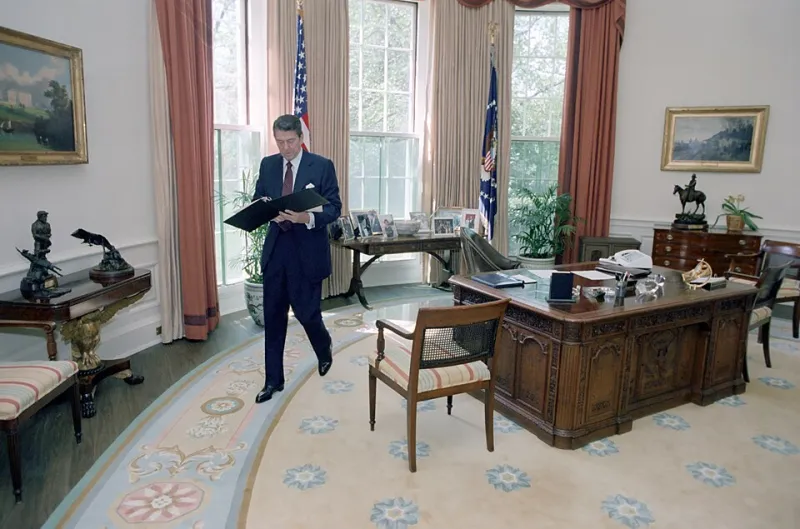
Photo: President (1981-1989 : Reagan). White House Photographic Office. 1981-1989, Public domain, via Wikimedia Commons
There's a particular kind of American hero we've been sold for a century: the confident one, the one who works a room, the one whose face ends up on the poster. The storyteller. The salesperson. The person who seems born for the spotlight.
And then there's everyone else.
Here's what gets lost in that story: some of the most important work in American history was done by people who would have rather died than give a TED talk. People who dodged photographers, turned down honors, and let louder colleagues absorb the applause. Their shyness didn't hold them back. In a strange way, it's exactly what made the work possible.
The Novelist Who Wouldn't Come Out of the Room
Start with Harper Lee. In 1960, she published To Kill a Mockingbird — a book that would sell more than 40 million copies, win a Pulitzer, and shape how generations of American schoolchildren think about justice. Her response to becoming one of the most famous writers alive? She stopped giving interviews almost immediately, left the literary party circuit, and split her time between New York and a modest life in Monroeville, Alabama.
For over half a century, she was arguably the most famous recluse in American letters. When a journalist finally tracked her down in the 1990s, she reportedly told him the fame felt like being hit over the head and having your pockets picked. The book did the talking. Lee never needed to.
The Man Who Gave Away the Credit
Or consider Norman Borlaug — though odds are you haven't, and that was partly his doing. Borlaug, an Iowa farm kid, developed the high-yield wheat varieties credited with saving as many as a billion people from starvation during the twentieth century. A billion. He won the Nobel Peace Prize in 1970, and when they came to find him for the ceremony, he was reportedly out in a Mexican wheat field at dawn, because that's where he always was.
Borlaug spent decades in the dirt, crossbreeding wheat by hand, letting foundations and governments take the podium. He didn't build a personal brand. He built a harvest.
The Engineer in the Back of the Room
The pattern runs through American engineering, too. Consider the women of NASA's early days — figures like Katherine Johnson, whose orbital calculations put astronauts on the right path and who, for decades, worked in relative anonymity while mission headlines went to men in helmets. Johnson herself was less interested in fame than in getting the math exactly right. When President Obama awarded her the Presidential Medal of Freedom in 2015, she was 97. The work had waited patiently; so had she.
There's a quiet kind of confidence in that. The quiet ones in the back row weren't waiting their turn to be loud. They were busy.
Why Modesty Made the Work Better
Here's the uncomfortable question: would these people have done better work if they'd been more charismatic? Almost certainly not.
Lee's distance protected the books from her own mythology. Borlaug's indifference to ceremony meant decades more time in the field. Johnson's focus on the numbers — not the narrative around the numbers — is precisely what made them trustworthy. Spotlight is expensive. It costs time, attention, and a certain kind of hunger. The people profiled here never paid that tax, and the savings went straight into the work.
There's also a humility dividend. When you don't think you're the story, you listen harder. You notice what's actually broken instead of what photographs well. You're willing to be wrong in public because you were never performing in the first place.
The Myth We Keep Telling
American culture has a stubborn belief that influence requires a personality to match — that to change things, you must first sell yourself. But look closely at the people who actually bent history, and you'll find a surprising number who never asked to. They asked to be left alone with the problem.
So if you're the quiet one in the back row, take heart. The spotlight is a tool, not a qualification. Some of the most extraordinary lives in this country's story were led by people who would have turned down the invitation — and changed everything anyway.
Rise From Modesty, indeed.