When Everything Broke, the Thinking Got Clearer: Science's Finest Disasters
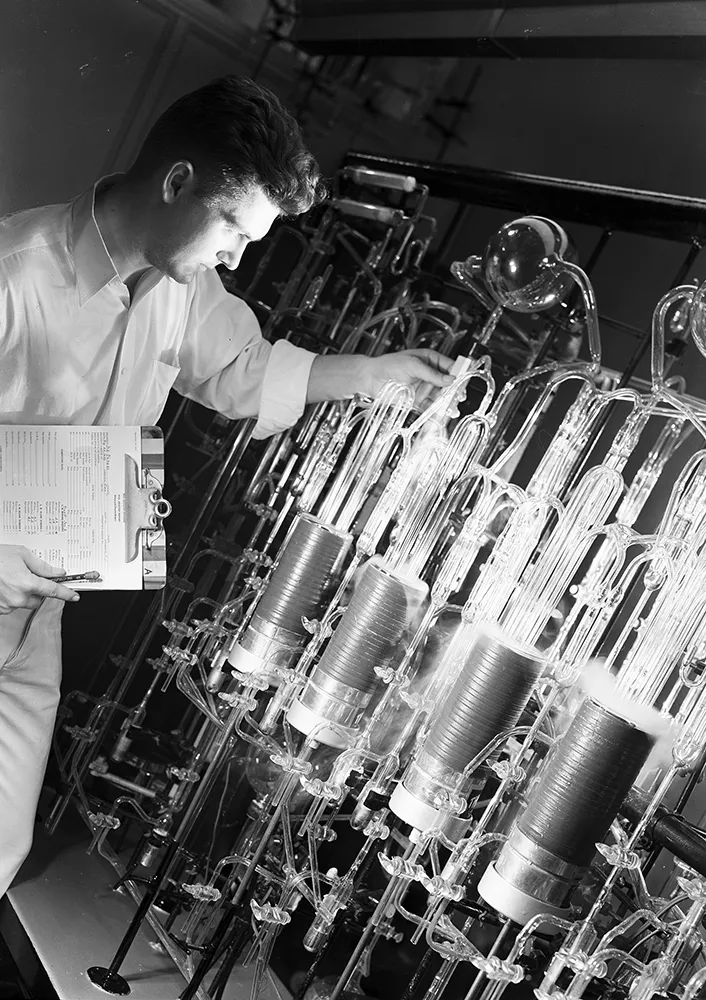
Photo: Robert Yarnall Richie, No restrictions, via Wikimedia Commons
Ask a lab director what they need and you'll get a predictable list: more funding, more staff, more time, better equipment. It's a reasonable list. It's also, if history is any guide, slightly beside the point.
Because when you go looking for America's great scientific breakthroughs, you keep finding them in the wreckage. Not in the well-funded golden years — in the blackouts, the wars, the shortages, the accidents. Over and over, the breakthrough came from the disaster, not despite it.
I'll go a step further and say something unfashionable: constraints don't merely test great minds. They create the conditions great minds need. And a culture that treats every limitation as a reason to wait is a culture that will wait a very long time.
The Wartime Kitchen That Changed Everything
Consider one of the most consequential scientific stories of the twentieth century, and note how it starts: with a shortage.
During World War II, the government needed to ship food overseas without it spoiling, and the usual methods weren't cutting it. Research into preservation, dehydration, and packaging accelerated dramatically — not because someone got a generous grant, but because the alternative was soldiers going hungry. Wartime food science gave us advances in preservation and nutrition standards that flowed straight back into American kitchens after the war. Frozen food, improved canning, mass-scale logistics of nutrition — the crisis wrote the recipe.
The same pattern runs through wartime medicine. Penicillin went from a laboratory curiosity to an industrial-scale lifesaver because the war created both the urgency and the forced cooperation to figure out mass production. Deep-sea diving science, aviation medicine, blood plasma logistics — each leapt forward because the constraint wasn't optional. Nobody could say "we're not ready." Ready or not was the same thing.
Lights Out, Ideas On
Then there are the accidents — the times the equipment failed and the failure itself became the discovery.
The most famous example in the American canon is the microwave oven, which was born when a Raytheon engineer named Percy Spencer stood in front of an active radar magnetron and noticed the chocolate bar in his pocket had melted. The radar program — itself a product of war — melted his candy, and he had the wit to pay attention instead of changing his coat. Popcorn kernels followed. So did an egg that exploded in a colleague's face. Out of that mess: a kitchen revolution.
The pattern repeats across the century. X-rays were found by accident. Vulcanized rubber came from a carelessly dropped mixture on a hot stove. Teflon emerged from refrigerant research that went sideways. Post-it adhesive came from a glue that failed at being glue. In each case the constraint or the mistake didn't block the discovery — it redirected the researcher toward something no plan would have found, because no plan would have thought to look.
What Scarcity Actually Does to a Mind
It's worth asking why this happens, because the mechanism matters.
Abundance encourages incrementalism. When resources are plentiful, the rational move is to protect them — to fund the safe next step, to refine what exists. Scarcity flips the incentives. When the normal path is unavailable, the weird path becomes competitive. When you can't ship fresh food, preservation genius matters. When you can't get the right material, you invent a substitute — and the substitute is sometimes better than the thing it replaced.
Scarcity also collapses the approval loop. Wartime America didn't have the luxury of five-year review cycles. Decisions that would take a decade in peacetime happened in months, because the cost of delay was visible and immediate. Bureaucracy is a luxury of safety.
None of this means disaster is good. It means disaster strips away the excuses. The minds were always there — Percy Spencer was always that curious — but the constraint gave them permission and pressure in the same instant.
The 'We're Not Ready' Problem
Which brings us to now, and to the part of this argument that I'll own as opinion.
We live in an era where "we're not ready" has become the default institutional answer to big problems. Not enough data. Not enough funding. Not enough consensus. The conditions aren't right. Wait.
But the historical record suggests the conditions are never "right" in the comfortable sense. The penicillin pipeline was built while the war was losing. The food science happened while ships were sinking. The breakthroughs came from people who treated the constraint as the assignment rather than as the excuse.
There's a real difference between prudence and paralysis, and we've gotten bad at telling them apart. Prudence says: here's the constraint, here's what we can do inside it, go. Paralysis says: here's the constraint, so we can't. The scientists in these stories all chose the first sentence. So did the engineers, the doctors, and the kitchen chemists.
The next time a problem looks too big for our resources, it might help to remember how the microwave was invented — by a man with a melted candy bar and no plan. The lights went out. The thinking got clearer.
Maybe that's not a paradox. Maybe that's the method.